Transnational Transracial Adoptees and Adoptee Awareness Month
A note before we begin: This post talks about loss, identity, gratitude expectations, and the ways Adoptees are sometimes dismissed. It’s a lot of information, so read it slowly. Take breaks as needed, and stop whenever you want to.
November carries two names. Nationally, it is National Adoption Month, an observance led by the federal Children's Bureau that focuses on children and youth in foster care who are waiting for permanent families (Children's Bureau, 2024). And many Adoptees also call the same month Adoptee Awareness Month, and the difference between those two names is bigger than a single word.
This post is for Adoptees, the people who love them, and everyone within the adoption constellation who makes decisions that shape an adopted person's life.
— · —
Why the Name Matters: Adoption Awareness vs. Adoptee Awareness
"Adoption awareness" points at an event. It asks us to notice a process: a placement, a finalization, a court date, a family being formed. The child in that picture is usually small, the moment is usually happy, and the person with the most to gain is often imagined to be the adult doing the adopting. Adoptee writers have argued that the month, as it is typically framed, speaks mostly to prospective parents and says little to the people who live as adopted persons for the rest of their lives (Plana Magazine, n.d.).
"Adoptee awareness" points to the person. It asks us to notice who that child becomes, and to stay interested after the paperwork is signed. The Adoptee at five is also the Adoptee at fifteen, at thirty-five, and at sixty-five, with questions about identity, origin, loss, belonging, and family that change shape across a lifetime. A month named for the Adoptee keeps that whole span of life in view.
The shift in language also moves the center of authority. An awareness month about adoption can be led, interpreted, and narrated entirely by people who have never been adopted. An awareness month about Adoptees invites the people with the lived experience to say what the experience is. Arguably a small change in grammar, and yet a seismic shift in whose knowledge is consulted.
Awareness of adoption is easy to come by. Awareness of adoptees requires listening to us.
None of this erases the children in foster care who are waiting for families, and it does not ask anyone to stop caring about them. It asks that the care be informed by the people who have lived on the other side of those decisions.
— · —
Four Words That Are Not Interchangeable
People often use "Adoptee," "international Adoptee," "transracial Adoptee," and "transnational Adoptee" as if they were a turn of phrase, and they are not. Each one points to a different set of experiences, and a person can carry one, two, or all of them. The distinctions matter because the losses, the questions, and the kinds of support that help can look quite different.
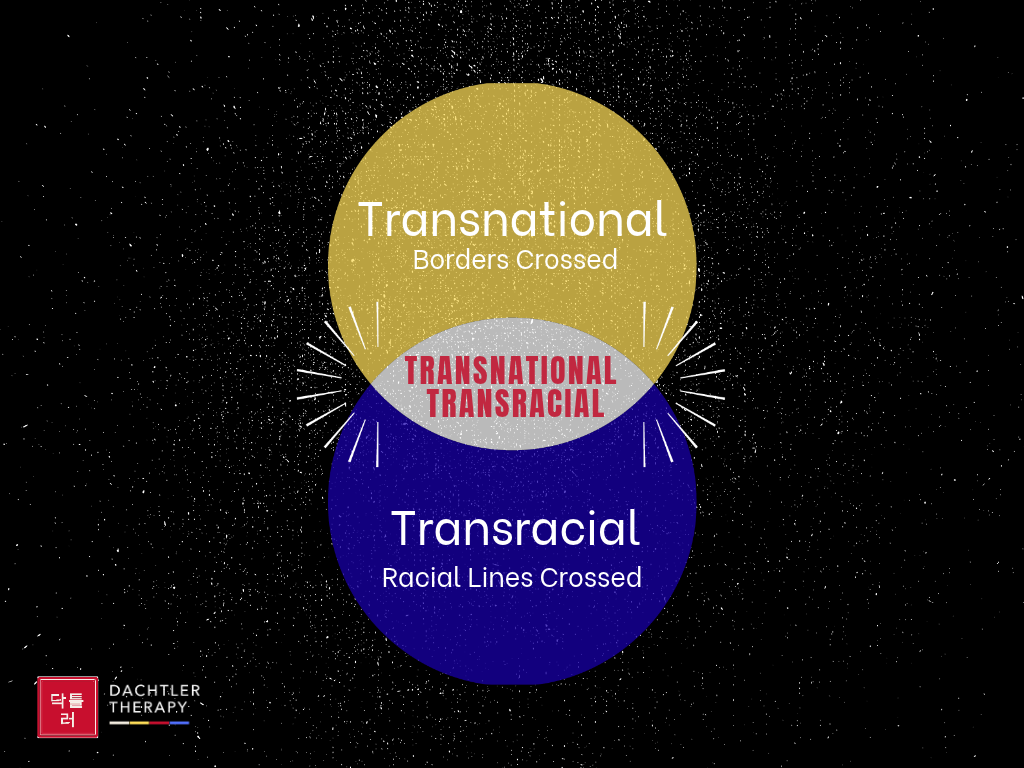
The above diagram demonstrates the differences between such experiences. The circles overlap, but neither one contains the other, and many adoptees sit outside both circles.
Guiding Definitions
Adoptees
Any person who was adopted, including infants, former foster, kinship, and adoption by a stepparent, and so on. An Adoptee can be adopted by a family of the same race, in the same country they were born in, and still carry real questions about origin, loss, family history, and belonging.
Shared ground: adoption means a legal and relational family change, often with loss attached.
Transnational Adoptees
People who were born in one country and adopted into a family in another. Alongside the usual adoption questions come others: a birth country that may feel both foreign and foundational, a first language that was lost, citizenship and paperwork, records that may be hard to trace across borders, and the question of what it means to have been moved from one place to another as a child.
Not all transnational Adoptees are transracial. A child adopted across borders into a family of the same racial background is still transnational.
Transracial Adoptees
People adopted by parents of a different race than their own. This can happen entirely within one country as it is not synonymous with transnational adoption. A Black child adopted by White parents in the Midwest is transracial without anyone crossing a national border. The central experience is often growing up as the racial minority inside your own family, where the people who love you most may not share your experience of how the world sees you.
Not all transracial Adoptees are transnational.
Transnational Transracial Adoptees (TTAs)
People who are all of the above (adopted, transnational, and transracial). They were adopted across national borders and into a family of a different race. Stacked, the two identities include the loss of country, language, and culture, and a daily experience of being racially different from the family, and often from the surrounding community. TTAs are also frequently treated as ambassadors for an entire culture they were removed from, or as perpetual foreigners in the only country they have known.
TTA is the community our founder belongs to and the community that centers Katherine’s research.
Why spend this much time on vocabulary? Because "Adoptee" as a single category flattens people. A support group that fits a domestic infant adoptee may miss what a TTA needs, and advice written for adoptive parents of one kind of adoption can land badly for another. Precision is one of the first forms of respect.
— · —
What Did Katherine Research?
Katherine recently defended her doctoral dissertation to earn her PhD in Change Leadership for Equity and Inclusion from the University of Central Arkansas. Its title is Transnational Transracial Adoptees in Mental Health: Lived Experience as a Catalyst for Identity and Liberation. The work is now being shaped into journal articles, and we’re excited to share it once they’re published. She is choosing to wait because the people who trusted her with their stories deserve to have them presented carefully and in full. Today, we can share the thinking behind it.
The study listens to TTAs who are also mental health clinicians, and it asks two big questions. First, when a therapist shares the experience of being a TTA with a TTA client, how does that shape trust, the working relationship, and what healing can look like? Second, how do TTA clinicians use their leadership to push the mental health field toward care that is actually responsive to Adoptees and their cultures?
The framework underneath is cultural humility. It’s a phrase that gets used loosely, so here is what it means in Katherine’s research: competence implies you can finish learning about a culture, like completing a course. Humility says you never finish. You stay curious, you let the person in front of you be the expert on their own life, and you pay attention to the power in the room. For adoption work, Katherine conceptualized an Adoptee-specific, clinical version of this as adoption-humility.
The research also draws on a model of how TTAs develop their identities (Asaro, 2022). In everyday terms, it describes five ongoing processes. None of them are steps with a finish line, and many people circle back through them more than once:
Coming to terms with being adopted and making meaning of your own adoption story
Coping with how the larger world relates to you and the assumptions it makes about you
Building a personal sense of family that reflects your actual, unique experience
Developing a sense of your racial and cultural niche
Learning that TTA is a social phenomenon, and seeing where your story fits in that larger history
That last one is a quiet turning point for many people. It’s the moment you realize your story is not a private defect or a one-off puzzle, but part of a pattern with a history, a set of institutions, and a community of people who have walked similar ground.
— · —
Coming Out of the Fog
Many Adoptees use the word fog to describe a period of life, sometimes decades long, when the hard questions stay just out of view. It is often unpacked as fear, obligation, and guilt.
Fear of rejection or abandonment, of asking something that might hurt a parent, or of what answers might exist.
Obligation to be grateful, to be the good kid, to prove that the adoption was a success.
Guilt for wondering, grieving, being curious about a first family, or feeling anything other than thankful.
One Adoptee, writing about her own experience, describes a life that looked fine from the outside while an unnamed undercurrent of questions ran below it, and says that coming out of the fog began when she "stopped being afraid of the questions" (Pestes, 2026). She doesn’t describe it as a single dramatic moment, but as a slow shift, and, in the end, as learning to live peacefully with questions that may never get one final answer.
Coming out of the fog is not about rejecting the people who raised you. It is about no longer having to protect everyone else's comfort at the cost of your own truth.
A few things are worth saying because people often miss them.
The fog is not a diagnosis, and not every adoptee experiences it. Some people never use that word. Some have a gentler road. The language is a tool that helps many people name something, and it is not a test anyone has to pass.
Coming out can be disorienting. When the fog lifts, grief and anger that had nowhere to go often arrive all at once. Relationships with adoptive parents can wobble. Some adoptees feel like they are betraying their families; others feel more honest and, eventually, closer. Both outcomes are common, and neither measures how well someone is doing.
Gratitude and grief can live in the same body. A person can love their adoptive family deeply and still mourn what they lost due to adoption. Holding both is not ingratitude.
Nobody can be pushed out of the fog. A good support person, whether a friend, a parent, or a therapist, makes it safer to ask questions and does not demand that the questions get asked on a schedule.
— · —
The Infantilization of Adult Adoptees
Here is something adoptees rarely hear but many have experienced. Many adopted people are treated as children long after they have become adults. Adoption is told as a story about a child being rescued, a family being completed, a happy ending. That story has no room for a fifty-year-old with strong opinions about how adoption works. So when adult adoptees speak, a surprising number of people respond as if a child had spoken, and that can sound like:
"You should just be grateful. Think about how it could have gone."
"Your parents did the best they could, so you shouldn't feel that way."
"You were chosen!"
"Why do you need to know about your birth family? Isn’t that ungrateful to your family?
Don’t you want to find your real family?"
"You're just angry. You'll feel differently when you're older." (said to someone who is 10, 20, 30, 40…)
Adoptive parents, agencies, or professionals speaking on behalf of Adoptees in rooms where Adoptees are present, or absent.
The pattern runs deeper than rude or ignorant comments. In many places, adult Adoptees have faced legal limits on seeing their own original birth certificates, with access rules that vary by state (Child Welfare Information Gateway, 2020). Imagine being a grown adult and needing permission from a court or agency to see a basic record of your own beginning; it’s infantilization built into paperwork. For TTAs, there is often a second layer, as many are also cast as perpetual foreigners or as spokespeople: asked where they’re "really" from, complimented on their ability to speak English, or invited to speak for an entire culture they were separated from. It is an odd double bind to be treated as a child in one breath and as an expert on a whole nation in the next. The tangible impact occurs when Adoptees learn their questions make others uncomfortable, so they stop asking. They learn that gratitude is the price of belonging, so they keep performing it. These learned social behaviors, or survival skills, demonstrate how the fog gets so thick in the first place.
A simple test: If an Adoptee were not adopted, would you say this to them? If the answer is no, it is probably worth rethinking. Adult Adoptees are experts on their own lives, and they are allowed to critique the institution that shaped them and own their life experiences without being told to feel lucky.
— · —
Listening to Adoptee Scholars: Why the Whole Constellation Needs To
Adoption professionals sometimes use the phrase adoption constellation to describe everyone whose life is touched by adoption. That includes the Adoptee and their first family, the adoptive/foster/kinship family, and also the professionals and systems that move the process along. Each of those people makes decisions, big and small, that the Adoptee will live inside for decades.
Adoptee scholars, researchers, authors, and clinicians have been documenting what those decisions feel like from the inside, in peer-reviewed journals, memoirs, and books written for families. This body of knowledge is not a side conversation to the "real" professional literature. It is expertise the professional literature has too often lacked. Here are some of the adoptee voices whose work we return to, with the caveat that this list is a starting point, not a complete map.
Dr. Susan Branco is a counselor educator and a TTA from Colombia who helped originate the Adoptee Consciousness Model, a framework for the journey many Adoptees describe as moving beyond the fog (Branco et al., 2023; Branco et al., 2025). Her research also examines adoption and substance use (Branco et al., 2021) and Colombian Adoptees' identity and first family reunions (Branco et al., 2022; Cloonan et al., 2023).
Dr. JaeRan Kim is a social work scholar whose research examines adoption-specific curricula, post-adoption family support, and what happens when intercountry adoptions are disrupted (Kim, 2017; Kim & Tucker, 2020; Koh et al., 2017).
Dr. Kimberly McKee writes about the politics of Korean adoption, including the money that moves through the transnational adoption system and the way adoption intersects with reproductive justice (McKee, 2016, 2018, 2019, 2023).
Dr. Kim Park Nelson centers Korean American Adoptees in conversation with Asian American experience and racial exceptionalism, which is a lens many TTAs find missing from both adoption and Asian American spaces (Park Nelson, 2016).
Sandy White Hawk, a Sicangu Lakota adoptee, founded and directs the First Nations Repatriation Institute and tells her own story of return in A Child of the Indian Race (White Hawk, 2022). Her work reminds us that Native adoption history sits in a different legal and cultural context than transnational adoption, a point we explored in October’s blog post.
Dr. Aeriel Ashlee is a college counseling faculty member and a TTA whose writing and research explore the racialized experiences of transracial Asian American Adoptees (Ashlee, 2018).
Dr. Sara Docan-Morgan studies how Korean Adoptees and birth families communicate and build belonging during reunion (Docan-Morgan, 2016, 2024).
Amy Wilkerson, a TTA and licensed clinical social worker, wrote Being Adopted for younger adoptees, with a guide for caregivers (Wilkerson, 2021).
Jane Jeong Trenka is a Korean Adoptee and author of the memoirs The Language of Blood and Fugitive Visions, and co-editor of the landmark anthology Outsiders Within (Trenka, 2003, 2009; Trenka et al., 2006).
Angela Tucker and Melissa Guida-Richards offer Adoptee perspectives in book form, in "You Should Be Grateful" and What White Parents Should Know about Transracial Adoption (Tucker, 2023; Guida-Richards, 2021).
The academic model Katherine drew on in her research (Asaro, 2022) sits in this same tradition. Taken together, these scholars give the rest of the constellation something rare in a field full of decisions made by outsiders: a body of knowledge shaped by the people who live the outcomes.
Here is what listening to it can change, role by role.
Adoptive parents and caregivers: Learning to hear grief as information, not criticism; keeping a child's culture, language, and first family in view rather than treating them as optional extras; and staying curious as the child grows into an adult with authority over their story.
Foster parents and kinship caregivers: Understanding that a child can love the people caring for them and still carry loyalty, loss, and questions about the people they came from.
Guardians ad litem and court-appointed advocates: Weighing a child's racial, cultural, and family connections as real components of well-being, and not only as background to the placement decision.
Judges and attorneys: Remembering that rulings about names, contact, records, and placement are not abstract. Adults who were once the children in those files are living with the results, and many of them have a great deal to say about what worked and what did not.
Child protection workers and caseworkers: Plan for cultural and family connection at the start, keep siblings and kin in the picture where safe, and treat an adoption as the beginning of a lifetime of support needs, not the end of a case.
Therapists and other helping professionals: Resisting the urge to pathologize Adoptee grief, ambivalence, or curiosity, learning how racial and cultural identity interact with adoption, and referring or consulting when the work moves beyond what we know.
Educators, pediatricians, and others who see Adoptees regularly: Avoid assumptions about "real" family, adjust classroom assignments like family trees, and treat an Adoptee's questions as normal, not a problem.
We want to be mindful as Adoptee scholars do not speak with one voice, and no single Adoptee represents anyone but themselves. The point is not to swap one set of authorities for another. It is to widen the table so that people who have lived adoption are among those deciding how adoption is practiced, taught, and supported. Many Adoptees have said versions of "nothing about us without us," and in a field built on decisions made for others, it is a fair standard.
In Katherine’s work, that principle shapes the research design as much as the therapy room. Her dissertation listens to TTA clinicians because the people closest to the experience are rarely asked to help build the care model that is meant to serve them.
— · —
Supporting an Adoptee Without Tokenizing Them
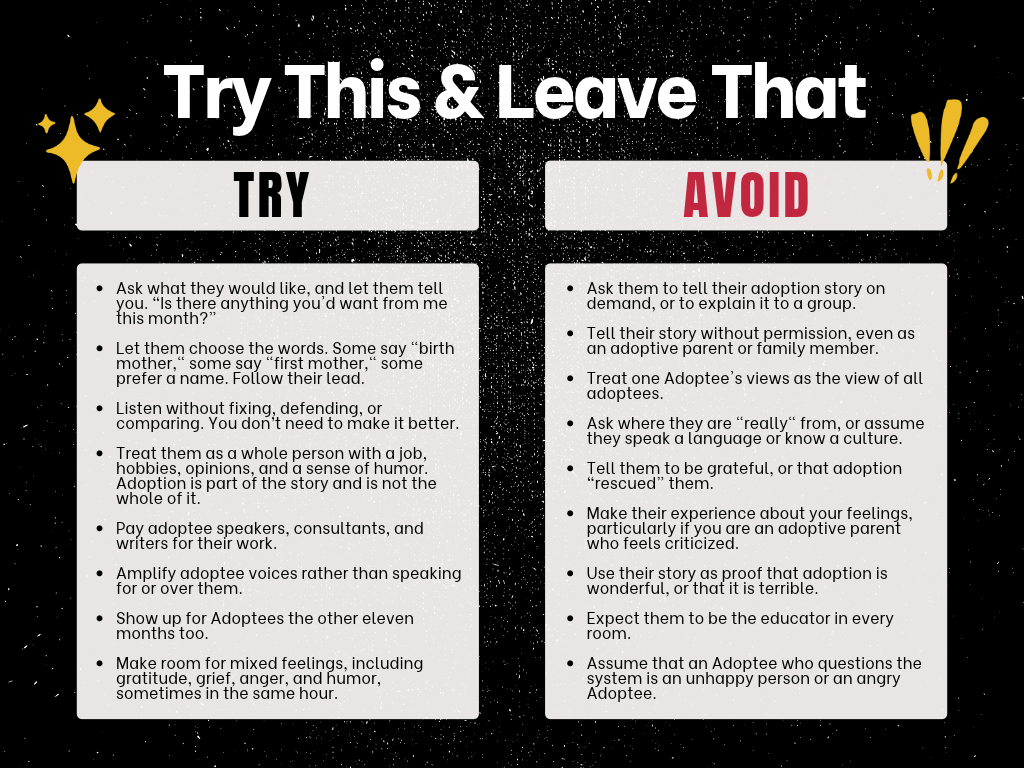
Tokenizing means treating a person as a symbol of a group instead of as a whole individual. It can happen with the best of intentions: the Adoptee who gets invited to every panel, asked to explain adoption to the whole office, or quoted in the newsletter every November and forgotten in December. Support that turns someone into a representative is not quite support.
No single script fits everyone, and adoptees disagree with one another about plenty. Still, these are the patterns I see help most often.
If You're an Adoptive Parent
When your adult child names pain about adoption, the work is to stay present without defending yourself. Their grief is not a verdict on your love. It is information about their experience, and you can hold your own feelings, ideally with your own support, without handing them the job of managing yours. If you are raising a child transnationally, transracially, or both, start with books written by Adoptees themselves, such as Tucker (2023) and Guida-Richards (2021). They can help you learn what the people you love may be carrying, and they are worth passing on once you have read them.
If You're an Adoptee Reading This
You do not have to be ready. You do not owe anyone a timeline, a tidy narrative, or forgiveness. If something in this post felt like recognition, you may be closer to the edge of the fog than you realized. If it felt like too much, close the tab and come back another day. Both or none are okay.
— · —
One Last Thing
Adoptee Awareness Month is not asking the world for pity, and it isn’t asking Adoptees to be louder. It is asking everyone else to listen better. To notice who has been doing the explaining, who has been doing the thanking, and who has been left out of rooms where decisions about adoption get made. Whether you are a parent, a judge, a caseworker, a clinician, or a friend, you hold a piece of an Adoptee's story, and how you hold it matters.
If you are an Adoptee, we see you in all of the shapes that word can take. If you love one, thank you for reading all the way down here. That is already a form of showing up.
For Further Learning: Books
"You Should Be Grateful": Stories of Race, Identity, and Transracial Adoption, Angela Tucker (Beacon Press, 2023)
What White Parents Should Know about Transracial Adoption, Melissa Guida-Richards (North Atlantic Books, 2021)
A Child of the Indian Race: A Story of Return, Sandy White Hawk (Minnesota Historical Society Press, 2022)
Invisible Asians: Korean American Adoptees, Asian American Experiences, and Racial Exceptionalism, Kim Park Nelson (Rutgers University Press, 2016)
Disrupting Kinship: Transnational Politics of Korean Adoption in the United States, Kimberly McKee (University of Illinois Press, 2019)
Adoption Fantasies: The Fetishization of Asian Adoptees from Girlhood to Womanhood, Kimberly McKee (Ohio State University Press, 2023)
In Reunion: Transnational Korean Adoptees and the Communication of Family, Sara Docan-Morgan (Temple University Press, 2024)
Outsiders Within: Writing on Transracial Adoption, edited by Jane Jeong Trenka, Julia Chinyere Oparah, and Sun Yung Shin (South End Press, 2006)
The Language of Blood (2003) and Fugitive Visions: An Adoptee's Return to Korea (Graywolf Press, 2009), Jane Jeong Trenka
Being Adopted, Amy Wilkerson (2021), a book for younger adoptees with a caregiver guide
For Further Learning: Peer-Reviewed Publications
Branco, S. F., Kim, J. R., Newton, G., Cooper-Lewter, K., & O'Loughlin, P. (2023). The Adoptee Consciousness Model: Moving beyond the fog. International Body Psychotherapy Journal
Branco, S. F., Kim, J., & Newton, G. (2025). The Adoptee Consciousness Model: Integration with family counseling theory and practice. The Family Journal
Branco, S. F., Stella, S., & Langkusch, A. (2022). The reclamation of self: Kinship and identity in transnational Colombian adoptee first family reunions. The Family Journal
Cloonan, V., Hatfield, T., Branco, S. F., & Dean, L. (2023). The racial and ethnic identity development process for adult Colombian adoptees. Genealogy
Kim, J. R., & Tucker, A. (2020). The Inclusive Family Support Model: A conceptual framework for working with families post adoption finalization. Child & Family Social Work
McKee, K. D. (2016). Monetary flows and the movements of children: The transnational adoption industrial complex. Journal of Korean Studies
McKee, K. (2018). Adoption as reproductive justice. Adoption & Culture
Docan-Morgan, S. (2016). Cultural differences and perceived belonging during Korean adoptees' reunions with birth families. Adoption Quarterly
Records and Access
Child Welfare Information Gateway: Access to Adoption Records (state-by-state information) childwelfare.gov
Whenever you're ready, we’re here.
— · —
References
Asaro, J. (2022). Identity development of transnational transracial adoptees (Publication No. 29168825) [Doctoral dissertation, Fielding Graduate University]. ProQuest Dissertations and Theses Global.
Ashlee, A. A. (2018, March 5). I am not confused: A transracial adoptee’s reflections on the confines of racial categories. NASPA. https://www.naspa.org/blog/i-am-not-confused-a-transracial-adoptee-s-reflections-on-the-confines-of-racial-categories
Branco, S. F., Jones, C. T., & Stella, S. (2021). Substance use disorders and adoption status: Implications for counseling practice. The Family Journal, 29(1), 109–114. https://doi.org/10.1177/1066480720956639
Branco, S. F., Kim, J., & Newton, G. (2025). The Adoptee Consciousness Model: Integration with family counseling theory and practice. The Family Journal, 33(2), 230–235. https://doi.org/10.1177/10664807241290244
Branco, S. F., Kim, J. R., Newton, G., Cooper-Lewter, K., & O’Loughlin, P. (2023). The Adoptee Consciousness Model: Moving beyond the fog. International Body Psychotherapy Journal, 22(3), 53–66.
Branco, S. F., Stella, S., & Langkusch, A. (2022). The reclamation of self: Kinship and identity in transnational Colombian adoptee first family reunions. The Family Journal, 30(4), 514–522. https://doi.org/10.1177/10664807221104112
Child Welfare Information Gateway. (2020). Access to adoption records. U.S. Department of Health and Human Services, Administration for Children and Families, Children’s Bureau. https://www.childwelfare.gov/resources/access-adoption-records/
Children’s Bureau. (2024). Children’s Bureau message for National Adoption Month 2024. U.S. Department of Health and Human Services, Administration for Children and Families. https://api.childwelfare.gov/adoptionmonth/childrens-bureau-message
Cloonan, V., Hatfield, T., Branco, S. F., & Dean, L. (2023). The racial and ethnic identity development process for adult Colombian adoptees. Genealogy, 7(2), Article 35.
Docan-Morgan, S. (2016). Cultural differences and perceived belonging during Korean adoptees’ reunions with birth families. Adoption Quarterly, 19(2), 99–118. https://doi.org/10.1080/10926755.2015.1088109
Docan-Morgan, S. (2024). In reunion: Transnational Korean adoptees and the communication of family. Temple University Press.
Guida-Richards, M. (2021). What white parents should know about transracial adoption: An adoptee’s perspective on its history, nuances, and practices. North Atlantic Books.
Kim, J. R. (2017). You can’t run into a burning building without getting burned yourself: An ecological systems perspective of parents choosing out-of-home care for an intercountry adopted child. Families in Society, 98(3), 169–177.
Kim, J. R., & Tucker, A. (2020). The Inclusive Family Support Model: A conceptual framework for working with families post adoption finalization. Child & Family Social Work, 25(1), 173–181.
Koh, B. D., Kim, J. R., & McRoy, R. (2017). Exploring adoption-specific curricula in undergraduate and graduate degree programs. Adoption Quarterly, 20(3), 252–265.
McKee, K. D. (2016). Monetary flows and the movements of children: The transnational adoption industrial complex. Journal of Korean Studies, 21(1), 137–178.
McKee, K. D. (2018). Adoption as reproductive justice. Adoption & Culture, 6(1), 74–93.
McKee, K. D. (2019). Disrupting kinship: Transnational politics of Korean adoption in the United States. University of Illinois Press.
McKee, K. D. (2023). Adoption fantasies: The fetishization of Asian adoptees from girlhood to womanhood. Ohio State University Press.
Park Nelson, K. (2016). Invisible Asians: Korean American adoptees, Asian American experiences, and racial exceptionalism. Rutgers University Press.
Pestes, L. (2026, August 30). Out of the fog. I’m Adopted. https://imadopted.org/adopteenotes/out-of-the-fog
Plana Magazine. (n.d.). National adoption month is for everyone but adoptees. https://planamag.com/national-adoption-month-is-for-everyone-but-adoptees
Trenka, J. J. (2003). The language of blood. Minnesota Historical Society Press.
Trenka, J. J. (2009). Fugitive visions: An adoptee’s return to Korea. Graywolf Press.
Trenka, J. J., Oparah, J. C., & Shin, S. Y. (Eds.). (2006). Outsiders within: Writing on transracial adoption. South End Press.
Tucker, A. (2023). You should be grateful: Stories of race, identity, and transracial adoption. Beacon Press.
White Hawk, S. (2022). A child of the Indian race: A story of return. Minnesota Historical Society Press.
Wilkerson, A. (2021). Being adopted. Fulton Books, Incorporated.